The Abandoned Shell: A Story of the Red Reef Lobster – Tales Beneath the Surface #11
The Abandoned Shell
A Story of the Red Reef Lobster
Tales Beneath the Surface #11
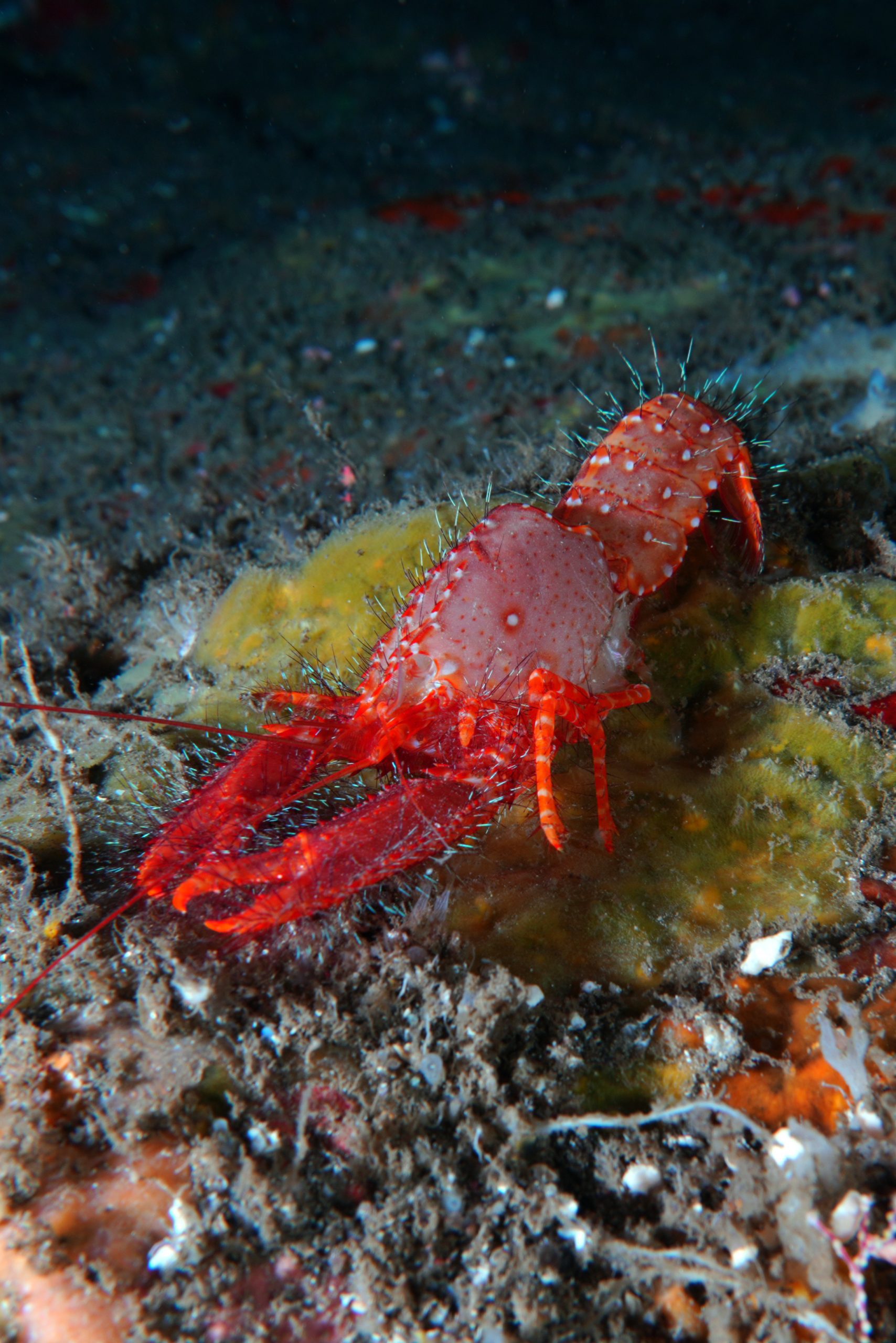
Red Reef Lobster (Enoplometopus occidentalis)
Introduction
In the underwater caves of Gili Biaha, light fades quickly and movement slows. These environments demand patience and precision. For many marine species, caves are not just shelters from predators, but essential spaces for survival during their most vulnerable life stages.
One of those stages is molting, a critical process for crustaceans such as the red reef lobster.
An Unexpected Discovery
While slowly exploring the cave system at Gili Biaha, our dive lights revealed a familiar underwater scene. Crabs pressed deep into rock crevices. Shrimps retreating into narrow cracks. Lobsters pulling farther into darkness at the slightest disturbance.
Then, on the rocky bottom, something unusual appeared.
A perfectly formed red reef lobster lay motionless. Antennae extended. Legs and claws intact. At first glance, it appeared lifeless, almost frozen in time.
A closer look told a different story.
It was not a lobster.
It was an empty shell.
How Red Reef Lobsters Grow
Red reef lobsters, like all crustaceans, cannot grow gradually. Their hard outer shell, known as an exoskeleton, does not expand as the animal grows. Instead, growth occurs through molting.
During this process, the lobster carefully exits its old shell, leaving behind an almost perfect replica of its previous body. Beneath the discarded shell, a new exoskeleton forms. At first, it is soft and flexible, offering little protection.
This transformation allows the lobster to increase in size, but it comes at a significant risk.
The Most Vulnerable Phase
Immediately after molting, the red reef lobster is extremely vulnerable. Its new shell requires hours, and sometimes days, to harden. During this time, the lobster avoids movement and hides deep within the reef structure.
Feeding often stops. Defense relies entirely on concealment.
This is why finding an intact lobster shell underwater usually means the animal has already survived the most dangerous part of the process and is hiding nearby, invisible to passing divers.
Why Underwater Caves Matter
Caves like those found at Gili Biaha provide ideal conditions for molting. Reduced light lowers predator activity. Solid rock offers physical protection. Stable conditions help conserve energy during recovery.
These caves are more than dramatic dive sites. They are critical habitats that support key biological processes for many reef species.
A Common Misunderstanding Among Divers
Many divers mistake an empty lobster shell for the remains of predation or a sign of death. In reality, a clean and intact shell usually signals successful growth.
It is evidence that the lobster has moved forward in its life cycle.
Underwater, growth rarely happens in plain sight. It unfolds quietly, hidden within cracks, caves, and shaded reef structures. Often, the only trace of transformation is what remains behind.
Final Thoughts
The abandoned shell of a red reef lobster is not an ending. It is a transition.
It reminds us that beneath the surface, survival depends not on speed or strength, but on timing, shelter, and patience. In the stillness of underwater caves, life continues to adapt, unseen and uninterrupted.
🦞 Quick Educational Summary
Key Facts About Red Reef Lobster Molting
Red reef lobsters must shed their entire exoskeleton in order to grow
Molting is the most vulnerable stage in their life cycle
An intact shell usually means the lobster survived and is hiding nearby
Underwater caves provide critical protection during this process
📍 Dive Site Information
Location: Gili Biaha, Bali
Dive Site: Gili Biaha Shark Cave
Species Featured: Red Reef Lobster (Enoplometopus occidentalis)
📍 ZERO GRAVITY DIVING, Sanur, Bali
🤿 Exploring Bali’s reefs with respect, patience, and curiosity
📞 WhatsApp: +62 821 4650 4530
🌐 https://zerogravitydiving.com/
🌐 https://zerogravitydivingbali.com/
📍 Google Maps: https://maps.app.goo.gl/wUiiDaHUDajCtTvb9
📷 Instagram: @zero_gravity_diving
#StoriesBeneathTheSurface #MarineEducation #RedReefLobster #LobsterMolting #MarineLifeBali #GiliBiaha #UnderwaterBiology #ScubaDivingBali
Contact Us for Scuba diving in Bali
Branko Milovanovic
Manager / PADI MSDT #279801
Mob / WA:+62 821 4650 4530
Office Tel: +62 361 4720 338
Zero Gravity Diving,
Jalan Sekuta No.40, Sanur
Denpasar, 80228 Bali, Indonesia